
2026 Election Information
Please find below important information concerning the Nov. 3, 2026 election:
Austin County ESD No. 1
Community Questions & Answers
November 3, 2026 Sales & Use Tax Proposition
Austin County Emergency Services District No. 1 (ESD 1) has placed a proposition on the November 3, 2026 ballot to adopt a local sales and use tax at a rate not to exceed 1.5% in any location in the district.
No location within ESD 1 would have a combined local and state sales tax above 8.25%. Approval of this proposition would not impact property tax rates,or authorize an increase in its maximum property-tax rate.
The ESD Board has called for an election as the district’s call volume, equipment costs, and operating costs continue to grow. If adopted, the District sales and use tax would apply to taxable purchases by both residents and nonresidents, subject to Texas sales and use tax laws
See “What does up to 1.5% sales tax mean?” below for an explanation of how Texas sales tax works and how the proposed tax could apply throughout the District.
Austin County ESD No. 1 provides emergency services throughout the district through the San Felipe-Frydek Volunteer Fire Department — including fire and rescue, motor vehicle accident and EMS response.
If the proposition passes , revenue from an ESD sales tax could be used for emergency-service expenditures — including training, fire apparatus and equipment, fuel, facilities, protective gear, maintenance and other operating needs. With the increasing costs of fire apparatus, equipment, protective gear and fuel, the revenue from the sales tax could be used to help offset such costs.
Call volume increased 20% from 2024 to 2025. Through August 2026, the department has already responded to 132 emergency calls, averaging approximately 16.5 calls per month, or one call about every 1.8 days. Historical call volumes also tend to increase during the latter part of the year.
The ESD Board has called for an election to assist the ESD in call volume, equipment costs, and operating costs continue to grow.
A sales tax is collected on taxable purchases made within the applicable portions of the district, subject to Texas sales and use tax laws. Sales tax collected can come from both residents and non-residents, including visitors, customers and outside businesses making taxable purchases within the district.
This is an important difference from property tax: sales-tax revenue can be collected involving people who do not live in the district.
For example, if the proposition passes, a person who lives outside ESD 1 but travels into the district to shop or conduct business could contribute to the sales-tax revenue generated there., Taxable purchases made by customers from outside the district would contribute to local sales-tax revenue if the proposition would pass.
Texas sales tax and how it works: Texas has a 6.25% state sales tax. Local governments may impose up to an additional 2% of local sales taxes, subject to Texas law, for a maximum combined state and local rate of 8.25%.
6.25% STATE TAX + up to 2.00% LOCAL TAX = 8.25% MAXIMUM COMBINED RATE
The proposed sales tax would be part of the local portion of the combined rate. It cannot cause the combined state and local sales tax rate to exceed 8.25%.
The amount of ESD 1 sales tax that could apply varies by location because different areas of the district already have different local sales tax rates. If the proposition passed, the proposed sales tax would increase the tax on applicable taxable transactions, subject to available local sales tax capacity at each location, with a maximum District rate of 1.5%.
For example, a 0.5% sales tax is $5 on every $1,000 of taxable purchases.
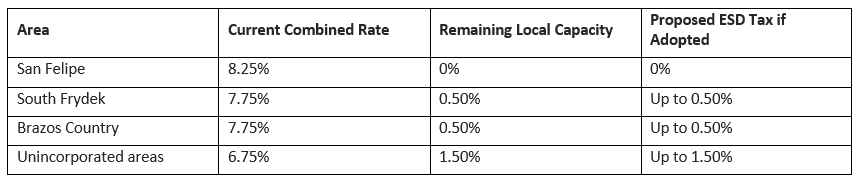
San Felipe is already at the 8.25% combined sales-tax maximum, so there is no remaining local sales-tax that can be collected in that areas.
This is not a special exemption created by the ESD Board. San Felipe is excluded because it is already at the legal local sales-tax limit.
The City of San Felipe contributes to the department’s emergency services as follows:
• The City of San Felipe owns the department's main fire station and provides it for the department's use at no cost.
• The city pays for the station's utilities, including electricity, phone, internet, and trash service, as well as insurance on the building.
• The city pays for maintenance and repairs to the station, including the water well and septic system, as well as building repairs and remodeling.
• The city maintains an annual budget allocation for the volunteer fire department when additional needs arise.
In addition, San Felipe residents remain part of ESD 1 and contribute to sales-tax revenue when they make taxable purchases in other areas of the district where the proposed tax applies.
The department responds to emergency calls throughout the district. Overall call volume increased 20% from 2024 to 2025. Within that overall volume, three core emergency response categories—fire, motor vehicle accidents (MVA), and EMS—account for a substantial portion of the department's emergency responses. Through August 2026, the department recorded 132 calls, including:
• 38 fire calls
• 47 motor vehicle accidents
• 21 EMS calls
The 47 MVA calls through August 2026 already exceed the full-year MVA totals for both 2024 and 2025.
Together, Fire, MVA and EMS accounted for 106 calls through August 2026, representing 80.3% of all 132 calls recorded in the first eight months of the year. The department has averaged 16.5 calls per month through August 2026, or about one call every 1.8 days. The department has historically seen call volume increase during the latter part of the year, so if this trend continues, call volume will increase through the end of the year.
ESD 1 budgets for recurring annual operating expenses and for capital and equipment needs.
Fire apparatus, protective equipment and other equipment have finite service lives and require replacement. New fire engines can cost $750,000 or more and, depending on the apparatus and specifications, can exceed $1 million.
The approved 2026–2027 ESD 1 budget includes $20,000 for capital replacement reserve. Building reserves over time allows the district to prepare for major equipment replacement and department growth, rather than waiting until a large purchase or expense becomes unavoidable. Some purchases, such as a fire engine, can exceed the district's annual revenue by a substantial amount.
Building reserves over time helps can assist in financial stability for predictable future needs while also providing a financial cushion for unexpected expenses. It is not the same as having excess money available for ordinary annual operations.
No. The district’s property tax and proposed sales tax are two separate revenue sources. Approval of this proposition would not itself change the District’s property-tax rate or authorize an increase in its maximum property-tax rate. ESD 1’s voter-authorized maximum property-tax rate is $0.03 per $100 of taxable property value. ESD 1's 3-cent property tax rate is substantially below the state’s authorized 10-cent maximum available to ESDs under Texas law; however, ESD 1’s property tax rate cannot be increased without voter approval. Increasing the District’s voter-authorized maximum property-tax rate would require a separate election. This proposition does not itself change the District’s property-tax rate.
No. The proposed ESD sales tax would not take or transfer any existing city sales tax revenue from incorporated areas within the district. The cities would continue to receive the local sales tax revenue they currently collect. The proposed ESD sales tax would use available local sales tax capacity within the applicable areas, subject to the 8.25% combined state and local sales tax limit.
Texas law specifically addresses situations where municipal annexation overlaps an ESD that imposes a sales tax. State law provides a mechanism for addressing the allocation of sales tax revenue when municipal annexation involves territory within an ESD. The effect of any future incorporation or annexation would depend on the circumstances and applicable law at the time.
To view a sample ballot for the Nov. 3, 2026 election please visit: https://www.austincounty.com/upload/page/0096/November%203%202026/Pct%204%20County%20and%20ESD.pdf
For general election information information, please visit: https://www.austincounty.com/page/austin.elections